The Lord Helps Those That Help Themselves
A Body of Work by Goldie Stilson
I have always been a tender person. Among my siblings I was always known as the "sensitive child" because I was often devastated by the smallest problem. Indeed it does seem like I've always been feeling things just a bit harder than other people; a raw nerve, you might say. For that reason, I seek to create a picture that can express those ideas which rub me the hardest in life. In creating a picture of it, I can gain mastery of it and hopefully finish with an understanding about the issue I'm addressing.
I seek to create a sort of hallucinatory image that, while rooted at its very core in reality, is not rational. One might find that the linear perspective is not "correct" or that the symbols are linked together more by my associations than by any rational relationship. I use these inconsistencies purposefully to enforce the surreal nature of the image. My paintings should not be interpreted as real spaces, but rather as metaphysical pictures in pursuit of what André Breton refers to as "the solution to the principal problems of life." (Le Manifeste du Surréalisme, 1924)
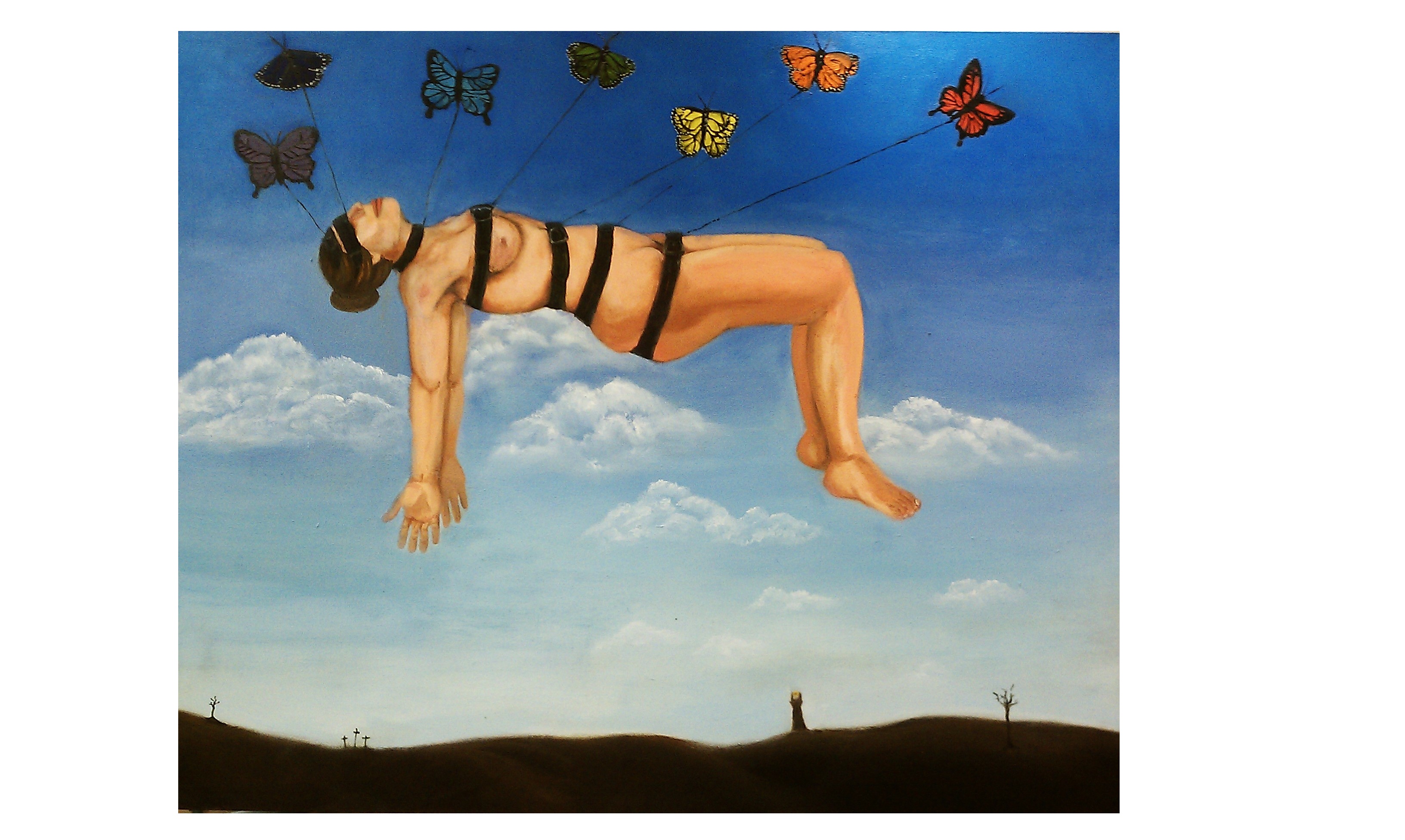
In Remembrance of Me, Oil on Canvas, 55" x 67"
I use symbols, all kinds of symbols mined from my own personal mythology to visualize disembodied ideas such as those of death and apocalypse found in my painting In Remembrance of Me. I chose this subject matter because it has effected me personally via my religiously based education, but also because I understand that these issues effect humanity on a universal level. Death effects everyone. Global catastrophe effects everyone. For this reason, I turn my personal feelings outward in an effort to understand, explain, remember, or document them in a way that can be understood by many.
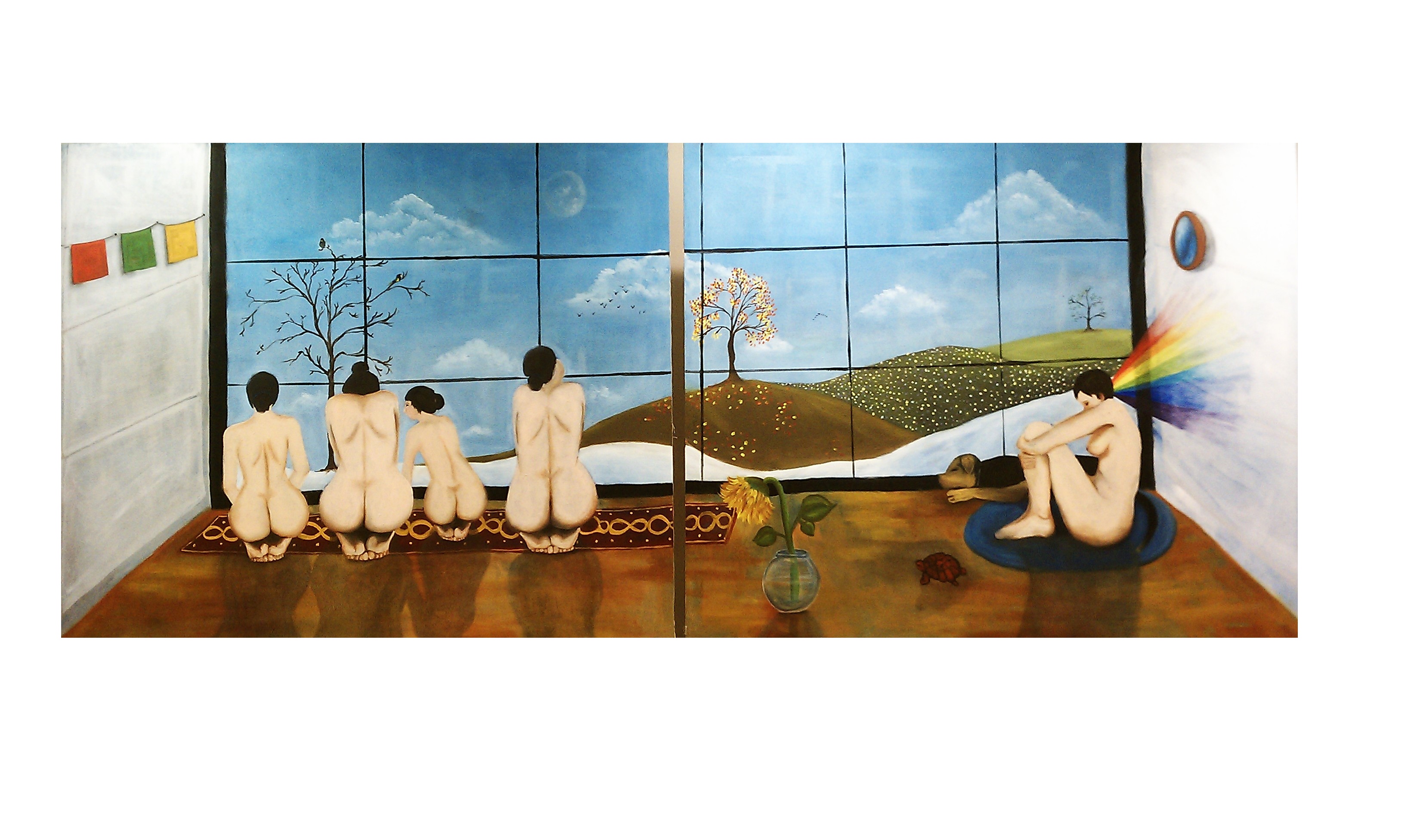
The Lord Loves The One Who Loves The Lord, Oil on Canvas, 55" x 144"
Another prominent theme in my work is addressed in the painting The Lord Loves The One That Loves The Lord... The theme is that of being misunderstood and alienated. Contemporary society generally subscribes the notion of the artist as an outsider, a bohemian, or a person whose mind does not work in a "normal" way. As an artist, I have struggled with the feeling of alienation from my peers as well as with the nagging feeling that my creativity is somehow a product of mental illness. The depiction of creative thought in this painting (seen as leaking from the back of the head) is an allusion to this fear. I use the visual metaphor of the dog to give comfort to the lone figure on the right in an attempt to portray the idea that, at the risk of sounding childish, being different is not always a bad thing. I use the sunflower as another symbol. This time using its association with Vincent van Gogh to reference the historic tradition of misunderstanding of artists. These symbols should ultimately add up to create an image of the idea. While it may not be able to solve the problem it addresses, it does at least open up space for a conversation about it.
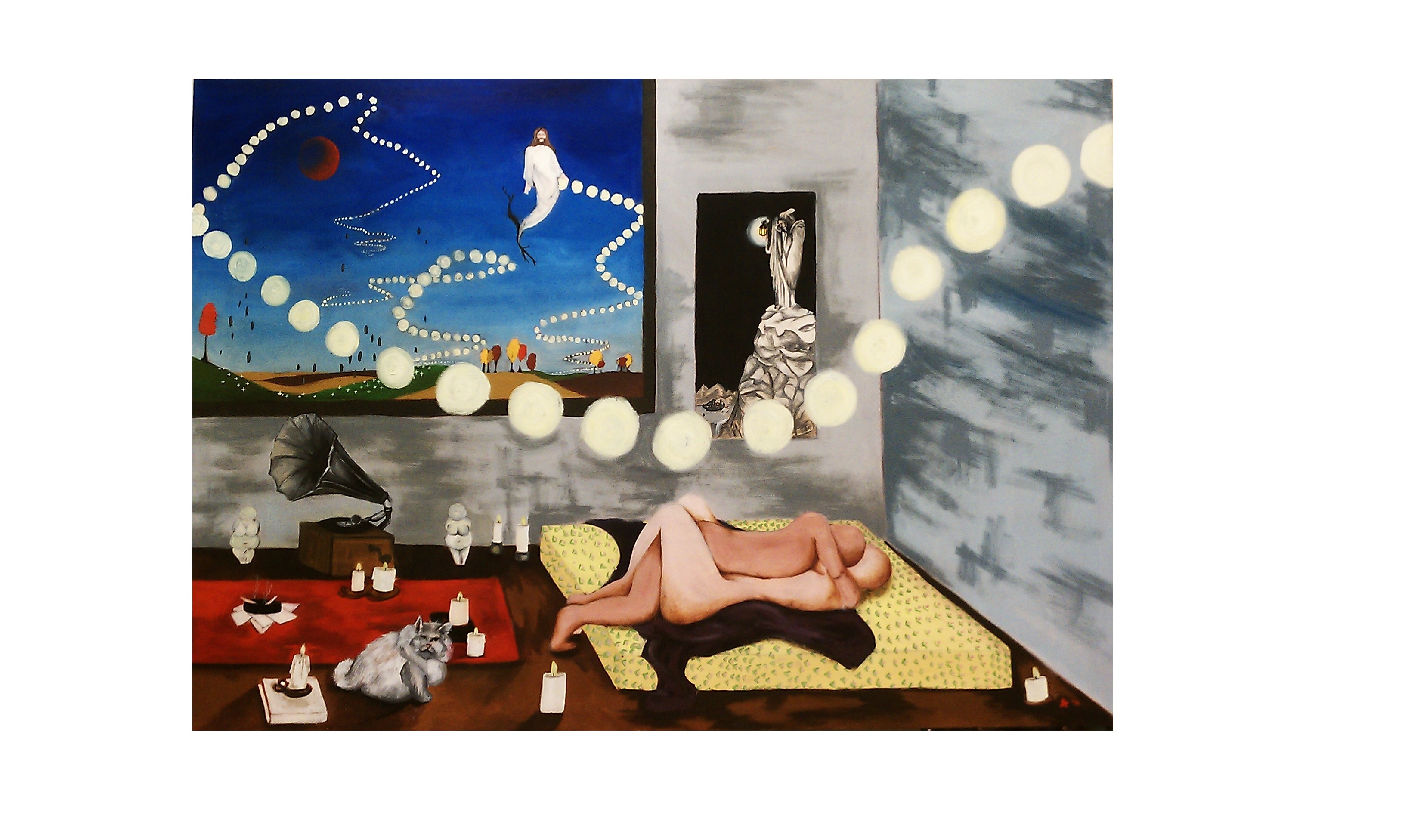
Two Things As One Thing, Oil on Canvas, 72" x 96"
The themes that I choose are not always entirely about anxiety or negative feelings. In the painting Two Things As One Thing, I juxtapose the animalistic pleasure of the youthful sex drive with the apocalypse scene outside the window. In this case, I seek to diminish the power of the negative imagery by surrounding it with the more positive imagery. The result should be a depiction of life mastering death, where the couple is so engaged in each other that even the end of the world cannot overcome them. To me, the picture is hopeful and uplifting at its core, but the complexity of the symbols I use leaves it open to a wide variety of interpretation.
My goal in creating this body of work is to share something of myself and to gain catharsis from the execution of the idea. I hope to share this cathartic experience with my viewers in an effort to gain collective knowledge about their subject matter and generate an atmosphere of solidarity found in our shared humanity.